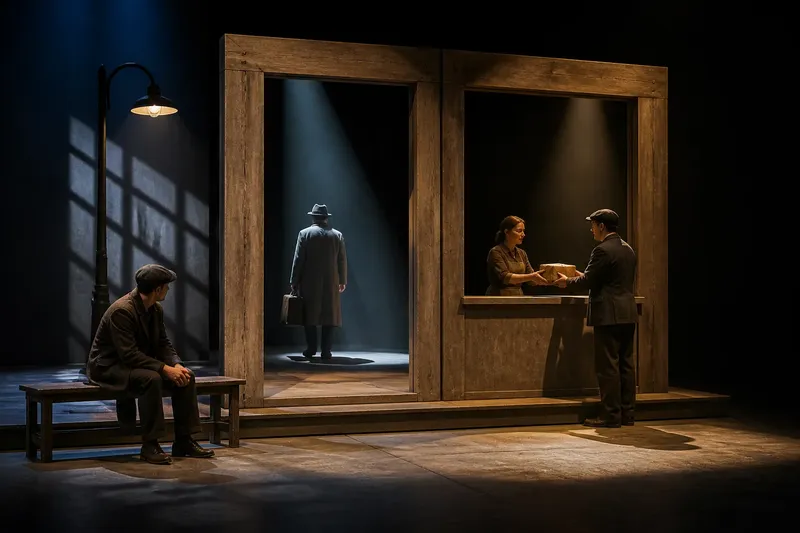
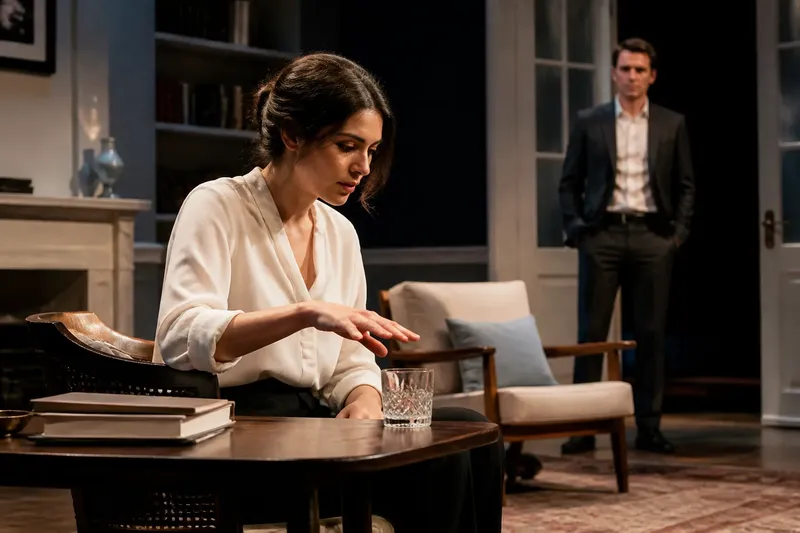
Warm Wash or Sharp Special: Two Ways to Direct Attention
Warm wash or sharp special: learn how broad coverage and a concentrated pool shape attention, keep key reactions visible and change how a scene reads.
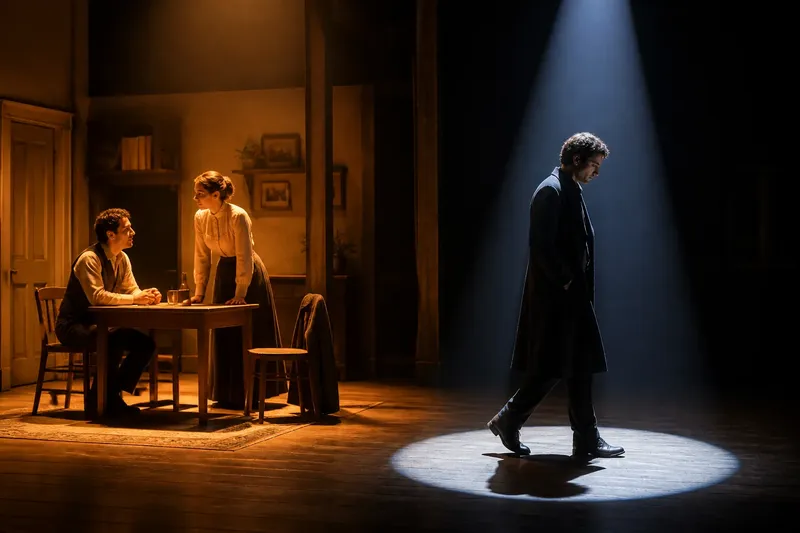
A performer crosses a dim stage while another stays beside a table. A broad amber glow can keep both in view, while a tight circle may leave the crossing figure in shadow. That contrast is at the heart of the warm wash or sharp special: one makes a shared space legible; the other asks the audience to look somewhere specific.
Neither choice is inherently more expressive. The effect depends on what is happening, how many points of attention matter, and whether viewers need to see the surrounding space. Watching the light can reveal how a production guides attention without dictating every response.
Two kinds of focus
A wash is a broad field of light across an area of the stage. It may look warm, perhaps amber or soft gold, but “warm” describes its appearance rather than its coverage. A wash can also be neutral or cool. Its defining feature is that it illuminates a wider zone rather than isolating one small target.
A special is a focused area of light intended to make a particular place, performer or object stand out. It may have a clean edge, a soft pool, or a shape tailored to the stage. “Sharp” describes a visible, defined edge, not every special: a beam can be softened to blend with its surroundings.
These terms describe functions, not necessarily separate pieces of equipment. Several lighting instruments can form a wash, while an instrument that contributes to broad coverage may also help shape a special. The useful question is what the light makes visible in relation to everything else.
What a wash shares
A broad wash gives the audience a field in which several people or objects can remain visible at once. That suits overlapping conversation, group movement, or action spread across the stage. Viewers can notice a listener’s response while still following the speaker, rather than being directed to one face alone.
A wash can also establish a sense of place. A table, doorway and performers may read as parts of the same room because they receive light together. Changes in colour or brightness can suggest a shift in mood or time, while broad coverage preserves the relationship between bodies and their surroundings.
Shared visibility leaves more choice with the audience. If a scene contains a quiet but essential action among other activity, a wash may not give it enough emphasis. Composition, movement, contrast or a change in light can make the action readable, but broad coverage alone does not select it.
Look across the lit area, not only at its brightest point. Ask which performers and objects remain available to your eye.
What a special selects
A concentrated special narrows the field of attention. It can isolate a speaker in a crowded scene, mark a still figure while others move, or make a small object feel newly significant. If the surrounding stage falls darker, the contrast between the lit area and what remains unseen becomes part of the image.
That selectivity can make a beat feel private or suspended. A performer alone in a pool of light may seem emotionally separate from the group, even if physically close to it. A sharp boundary can also make the stage look deliberately composed rather than like an ordinary room.
A narrow focus has costs. It can hide important reactions, make a nearby entrance difficult to follow, or leave the audience unsure whether an unlit figure is still part of the scene. A defined edge may draw attention to the light’s shape. If a performer moves beyond the pool, the change can be meaningful, but it may look accidental unless the action and light feel connected.
Notice what the darkness removes as well as what the beam reveals. The missing information is part of the choice.
Choosing between them
A wash often suits scenes where the audience should compare several people or track changing relationships across a shared space. It supports ensembles, social exchanges and choreography in which the whole stage picture carries meaning. It can also help when performers move freely through an area and no single point should dominate for long.
A special suits a moment with a clear visual centre: a solitary speech, a brief encounter, or an object whose significance should register before the surrounding action. It can serve a production that wants visible theatrical artifice rather than the impression of natural room light. A soft-edged special may make a gradual shift of attention; a crisp one can make the selection feel decisive.
Neither approach belongs to one kind of play. A quiet drama can use a sharp special for an abrupt change in perspective, while a stylised performance can use a wash to show several actions at once. The scene’s task matters more than a fixed rule about genre.
Questions about focus?
When does a wash work best?
A wash works well when several performers, objects or areas need to remain readable together. It is useful when viewers should choose among simultaneous reactions rather than follow one highlighted subject.
When does a special work best?
A special works well when one person, place or object should take precedence and the surrounding space can recede. It is effective when that narrowing of attention supports the scene rather than concealing information the audience needs.
Can a wash and special be combined?
Yes. A wash can keep the scene’s geography visible while a special gives one figure or moment extra emphasis. If the special dominates, the broader action may feel irrelevant; if it is too subtle, it may not change where viewers look.
How can viewers read the lighting?
Compare the brightest area with the less visible parts of the stage, then notice whether the contrast shifts with the action. Watch who stays visible, who disappears, and whether the change coincides with a line, movement or pause.
A useful way to choose
Start with the scene’s attention pattern. Is the audience meant to understand a shared situation, or concentrate on one point within it? If several reactions matter at once, broad coverage may support that reading. If a single event should interrupt or reorganise attention, a concentrated pool may be clearer.
Next, consider what must remain visible for the scene to make sense. A focused beam may emphasise a confession, but the listener’s response could matter just as much. A wash may keep both readable, though a shift in brightness, colour or positioning might be needed to distinguish the confession. The design question is not simply what to brighten, but which surrounding details belong in the audience’s view.
Movement matters, too. A performer crossing the stage may leave a tight special. The light can follow, the pool can widen, or the performer’s departure from it can carry meaning. Each option changes the visual rhythm: ask whether the light should stay with the person or let them leave its focus.
Say you are watching an invented scene in which one character quietly reads a letter while two others argue across a room. The starting point is that all three actions are visible, but the scene must make either the letter or the contrast between the characters its visual centre. First, if the letter’s contents are the central discovery, a special on the reader would draw attention there while the argument recedes; the expected result is that the audience follows the reading, with less access to the arguers’ reactions. Alternatively, if the reader’s silence should be compared with the argument, a wash would keep all three performers visible; the expected result is a fuller view of their contrasting behaviour, though the letter itself may receive less emphasis. The choice depends on which information the scene asks viewers to notice first.
Use these checks to decide what the audience should see:
- Points of attention: Check whether several actions matter at once; if they do, use broad coverage, but if one should lead, consider a special.
- Reactions: Check whether listeners or witnesses carry meaning; if they do, keep them visible with a wash or wider focus, but if their responses are secondary, let a special narrow attention.
- Surrounding space: Check whether the relationship between performers and scenery matters; if it does, preserve it with broad coverage, but if the setting should recede, use a more concentrated pool.
- Role of darkness: Check whether withholding parts of the stage supports the scene; if it does, use a special, but if the unseen area would confuse viewers, widen the light.
- Performer movement: Check whether someone travels beyond the lit area; if they should remain visible, follow them or widen the coverage, but if leaving the pool carries meaning, allow the contrast to remain.
- Edge and transition: Check whether the shift should feel gradual or decisive; if gradual, soften the edge or blend the change, but if a clear visual punctuation suits the action, use a sharper boundary or a more abrupt shift.
Reading the transition
The change between approaches can be as expressive as either look on its own. A wash that gradually narrows may draw attention towards a private thought. A special that opens into broader coverage can make a solitary moment feel connected to the group. If the shift happens suddenly, its timing can turn a line, gesture or entrance into visual punctuation.
Notice whether the transition follows the action or anticipates it. Light that changes just before a performer speaks may prepare the audience to watch them. A change after a reaction may instead make that reaction the point. A delay can leave viewers briefly uncertain, which may suit a scene about hesitation or exposure.
When you next watch a production, track one change from broad coverage to a focused pool, or back again. The warm wash or sharp special is not just a choice between seeing more and seeing less: it helps decide whether a scene asks you to compare its parts or attend to one of them. Notice what the light asks you to leave in the dark.