The Set That Changes Without Moving
Learn how a set that changes without moving uses performer position, light and sightlines to suggest new places, so you can read each scenic shift.
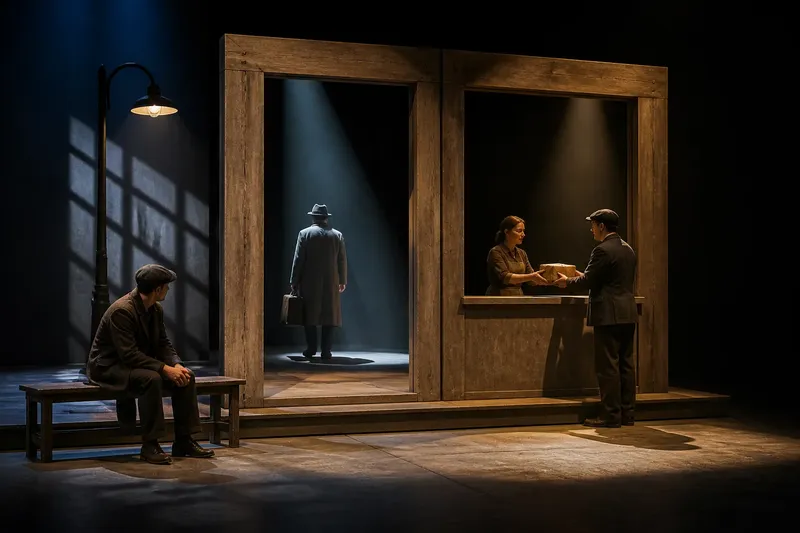
A wooden frame stands at the back of a stage. An actor steps through its opening, and it reads as a doorway; later, another performer waits beneath it while a narrow band of light crosses the floor, and the same frame feels like a station shelter. A set that changes without moving relies on a simple exchange: the object stays put while action and context guide the audience towards a new reading.
This approach is often called suggestive or transformative scenery. Instead of building a separate room for each scene, the designer gives a fixed element enough character to support several meanings. Performers, lighting and the audience’s viewpoint complete the change. The scenery is not disguised; its possibilities are made legible.
One object, several meanings
A scenic element might be a wall, platform, arch, staircase, table or suspended frame. Its shape and material offer clues without dictating one location. A rough timber wall might suggest a farmhouse, warehouse or exposed boundary, depending on what the scene asks the audience to notice.
Designers often choose an object with a clear physical identity but an open context. A doorway has a familiar function, yet it does not tell us whether it belongs to a home, workplace or public building. An actor can cross it as a neighbour, guard or traveller, while the scene’s behaviour supplies the setting.
Abstraction is not vagueness. A high sill, worn surface or unusually low opening can direct attention more effectively than decorative detail. Look for what the scenery establishes and what it leaves undecided.
Performer position
Actors change the apparent use of a set through their relationship to it. A ledge becomes a counter when someone leans across it to serve another person. It may read as a barrier when performers keep their distance and speak over it. A platform can suggest a bed, dais or vehicle deck according to how people gather, face and move on it.
These readings depend on purposeful action, not mime alone. An actor’s weight, gaze and timing establish a practical relationship with an object: resting, guarding an entrance or waiting for someone. When several performers respond to the same implied feature, the cue grows clearer. A group looking towards an opening makes it seem like a destination; one person blocking it may make it feel forbidden.
Movement also changes apparent scale. A performer close to a tall frame can make it feel imposing, while someone seated beneath it can turn it into shelter. The set remains identical, but the human body provides a reference for size and use.
Light and sightlines
Light selects parts of a fixed set and can give them a different context. Broad, even illumination may reveal the whole structure as a shared environment. A tighter area can make one corner feel private or isolated. Colour and direction may suggest time or atmosphere, but a useful scenic question is simpler: which surfaces can the audience see, and which recede?
Shadows can add depth without extra scenery. Light passing across slats may suggest an exterior boundary; a frame’s shadow may divide the floor into distinct areas. If a surface catches light differently from the surrounding stage, it can appear to form a separate plane. These effects are clearest when they support the action rather than compete with it.
A sightline is the view available from a particular seat. An opening may look like a passage from the centre of the auditorium but like a solid wall from the side. Designers consider how much of it remains visible across the room, and performers may adjust their position so an important action can be read. A set that depends on one narrow viewing angle may lose its meaning for some spectators.
Say a production has a fixed rectangular frame and a bench beside it. In this invented situation, an actor first waits on the bench and watches the opening; the audience can read the frame as a station entrance. Later, two performers exchange a parcel through it while the rest of the stage stays quiet; the frame may now read as a service window. The starting point is the same set, the action changes, and the expected result is a different interpretation without a moving wall.
Reading scenic shifts
Scenic shifts become easier to follow when you check several cues together. Use these observations to decide what the production is asking you to see:
- Check whether an actor crosses an opening; if the crossing is treated as arrival or departure, read it as a threshold, but if no one can pass through, consider whether it serves as a barrier instead.
- Check whether performers lean across a ledge to exchange an object; if they do, read it as a counter or service point, but if they keep apart, consider whether it marks separation.
- Check where the group directs its gaze; if several people watch the same opening, treat it as a destination, but if one performer blocks it, consider a forbidden or guarded entrance.
- Check which surfaces the light reveals; if one area is isolated, read it as a distinct place within the set, but if the full structure remains visible, consider a shared environment.
- Check whether the frame casts a clear shadow; if the shadow divides the floor, read it as an added boundary, but if it obscures the action, rely more on performers’ positions and gestures.
- Check whether the opening remains visible from your seat; if it does, use it to interpret entrances and exchanges, but if the view is blocked, follow the actors’ responses and the visible edges of the structure.
How can one set suggest two locations?
Give the fixed object a recognisable form but leave its specific location open. Then let performers’ actions and the visible part of the stage establish the new context.
Does the scenery need to look realistic?
No. It needs to communicate the relationships that matter, such as who can enter, where people can gather and what separates them. A selective or abstract design can make those relationships clearer than a detailed replica.
What should I watch when a scene changes?
Notice where performers stand, which way they face and what they treat as a threshold or boundary. Then observe whether the light reveals a different surface or leaves part of the set in shadow.
Why might a scenic shift feel unclear?
The cues may be too subtle, or several incompatible meanings may compete. If the action, lighting and visible geometry point in different directions, the audience has little basis for deciding how to read the space.
Clarity without realism
The designer balances invitation with precision. If an object carries too many unrelated associations, it may feel arbitrary. If its identity is too specific, it may resist a later scene. Ask whether the fixed element supports the production’s central relationships: separation, welcome, surveillance, confinement or transition. These relationships can carry across locations even when the scenery does not move.
Repetition helps the audience learn the production’s visual language. A threshold used first as an entrance and later as a point of refusal gains meaning through contrast. Reusing an object need not mean repeating an action; a new action can reveal another possibility in its shape.
Restraint matters too. If every scene adds a lighting cue, prop and gesture to explain the location, the fixed element may disappear beneath too many instructions. A few coordinated signals let the audience do imaginative work. Familiar actions—waiting, guarding, offering and crossing—often communicate without further explanation.
Watching the transformation
When a set changes without moving, track one stable feature and the people around it. Ask what the object permits, what it blocks and whether its apparent purpose shifts when a performer approaches or withdraws. Then consider the lighting and your seat: the same structure may be framed differently from one moment to another or from one part of the auditorium to another.
This way of watching treats scenery as active even when it is physically still. A fixed set can hold several places in reserve, and each performance moment selects among them. To read a scenic shift, notice the precise cue that changes the meaning: a hand on the edge, a body held back, or the part of the structure the light allows you to see.