From Street Clothes to Stage Costume
From street clothes to stage costume, learn how silhouette, fabric and wear help audiences read character, relationships and change across a performance.
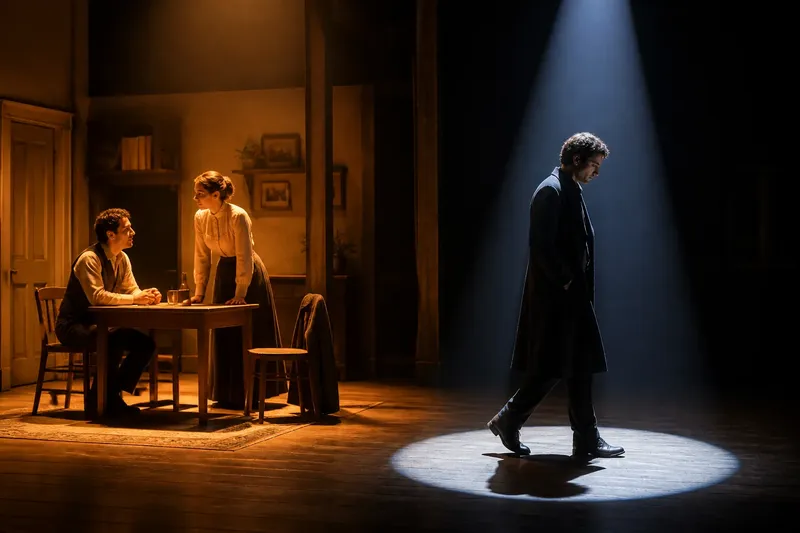
An actor crosses a rehearsal room in a plain coat; its loose shoulders and worn cuffs already suggest something about the character. From street clothes to stage costume, the shift is not simply from ordinary fabric to something grand. It is the point at which clothing is chosen and arranged to communicate within a particular production.
Clothing as costume
Everyday clothes can appear onstage without becoming a separate design language. A performer may wear a familiar shirt or jacket, but its colour, fit and condition still affect what the audience sees. Costume design makes those choices deliberate, even when the result looks ordinary.
A cloak might suggest travel or authority; an apron might connect a character with practical work. These are possible readings, not universal meanings. Their effect depends on the play’s setting, the production’s style and the audience’s own experience.
It helps to distinguish clothing worn during a performance from costume designed for one. The first describes a garment’s presence; the second considers how cut, colour, fabric, fit and condition contribute to the staging.
Conventions and character
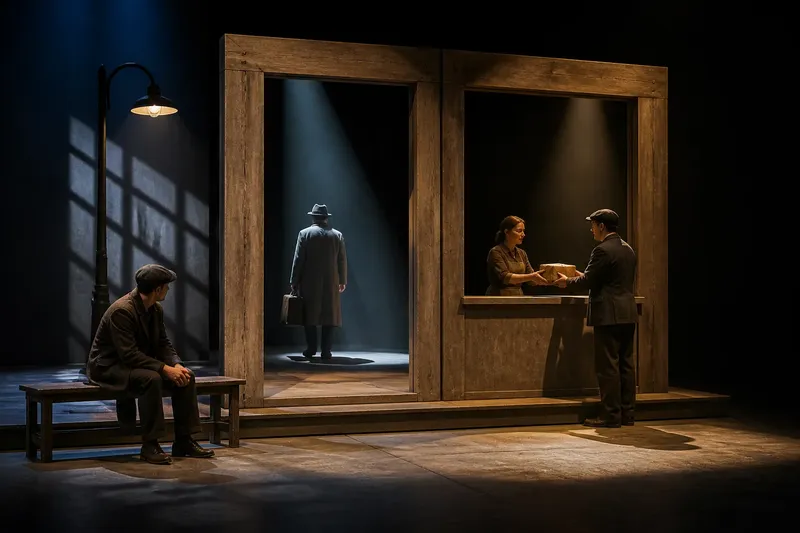
In a particular production, a shared visual convention can help audiences recognise rank, occupation or a character type. A distinctive hat, uniform or colour may be easier to read from a distance than a subtle detail. The convention belongs to the production’s chosen visual vocabulary; it should not be treated as a rule shared by every theatrical tradition or period.
Costume shorthand has a trade-off. It can orient an audience quickly, but it can also reduce a character to a familiar type. A designer might use a convention plainly, alter it, or set a character’s clothing against it. Each choice shapes whether the audience recognises the role immediately or notices a tension in how it is presented.
Look for a detail that repeats, changes or refuses an expected pattern.
Movement and fit
A costume must work on a moving performer, not merely on a mannequin. A stiff jacket can give the shoulders a squared outline; a loose sleeve may soften the arm’s shape. These effects can support a role, but the garment also needs to allow the actions required in the scene.
Fit has practical and visual consequences. Sitting, turning, reaching, handling props and changing backstage all place different demands on clothing. Shoes, fastenings and layers affect how a performer moves. If a hem catches or a collar shifts repeatedly, it can distract both actor and audience.
Say a director wants a character to seem guarded without adding a conspicuous prop. The designer tries a high fastening and a close-fitting collar, then the actor rehearses a scene involving a reach across a table. If the collar keeps the shoulders visually contained while the reach remains easy, the design supports the intention; if it restricts the action, the designer can loosen the fit or change the fastening.
Social signals
Clothing can suggest work, wealth, taste and belonging. A uniform may connect characters to an institution, while careful tailoring or visible repairs can point towards different circumstances. A character’s appearance may also express how they want to be seen: polished clothes can conceal unease, and deliberate informality can itself signal confidence or status.
Such meanings are culturally specific. A garment or colour may carry different associations for different audiences, so designers need to consider the play’s world and the people watching it. When a production draws on a living culture or a community unfamiliar to the creative team, consultation with knowledgeable people can help the design avoid careless assumptions.
Costume can also connect or separate characters. Related fabrics or repeated accessories may suggest a family or group; differences in finish or fit can reveal divisions within it. The audience may register the contrast without consciously naming it.
Realism and style
Naturalistic productions often ask clothes to belong plausibly to the world onstage. That does not mean copying street dress without thought. A contemporary jacket still has a silhouette, colour and level of finish, all of which affect how it reads under stage lighting and in relation to other designs.
Period costume poses a related choice. Historical research can help a team understand a garment’s construction and use, while theatrical clarity may call for selective emphasis or simplification. Accuracy and legibility can support each other, but they are not identical aims; the production’s style determines how they are balanced.
Ask whether the garment feels credible in the story and remains clear from the audience’s viewpoint.
Fabric and condition
Material affects how clothing holds its shape, reflects light and moves with the performer. A dense fabric may create a firm outline; a fluid one can fall in softer folds. Colour, texture, cut and the surrounding set all influence the impression, so no material carries a fixed meaning on its own.
Condition adds another layer. A sharply pressed garment can suggest care or formality, while softened edges or visible mending may imply repeated use. Wear should have a reason in the character’s circumstances: distressing clothes merely for atmosphere can turn hardship into decoration.
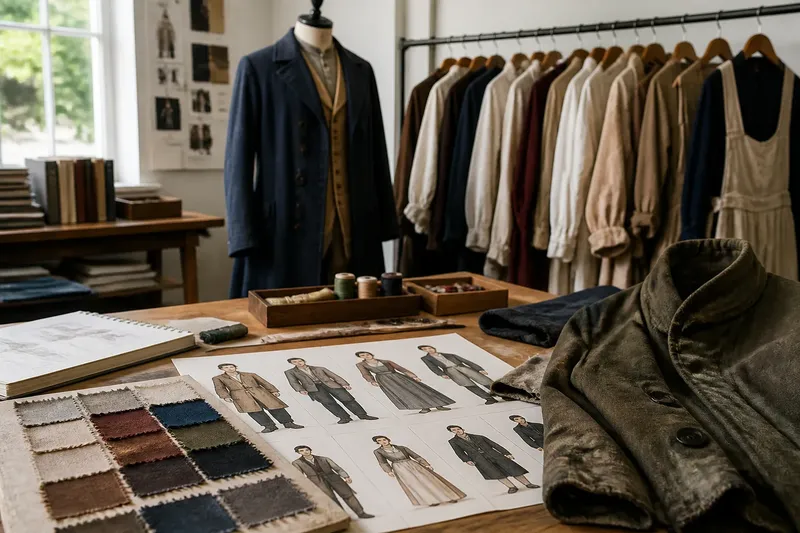
Designers can compare fabric swatches under the production’s lighting and against the set. A texture that seems clear at close range may disappear from farther back, so the useful question is what the audience can actually see.
Changes across a play
A change in clothing can register a shift in status, confidence, fatigue or circumstance without explanatory dialogue. The change may be large, such as removing a uniform jacket, or small, such as opening a collar. Repeated clothing can matter too: a coat worn in different settings may suggest habit, limited options or a need for continuity.
Imagine a character who begins in a carefully buttoned cardigan, loosens it during a private conversation, then buttons it again before meeting an employer. The actor’s action gives the audience a visible contrast between private ease and guarded formality. The cardigan does not explain the character’s feelings by itself; its meaning comes from when and how it changes.
Costume choices?
Why do actors wear costumes instead of their own clothes?
Designed garments help distinguish character, setting and relationship while fitting the production’s visual approach. They can also be selected to support movement, continuity and visibility, needs that personal clothing may not meet.
Does every costume need historical accuracy?
No. A production may pursue close historical detail, or use contemporary clothing and stylised forms. The choice should make sense within the production’s world and work alongside its acting and other design elements.
How can ordinary clothes become theatrical?
Selection and context do much of the work. A familiar coat can become expressive through its cut, condition, repetition or contrast with what other characters wear.
Who decides what a character wears?
The costume designer develops the visual approach with the director and wider creative team. The performer’s movement and practical needs also shape how the design works in rehearsal and performance.
Reading the costume
During a performance, notice which characters share colours or shapes, which garments look especially new or worn, and whether clothing changes alongside the action. Ask what a costume makes easy to understand and what it leaves uncertain.
Separate a garment’s literal use from its theatrical effect. A coat may keep a character warm in the story, while its size, condition or repeated appearance suggests something about status or memory. From street clothes to stage costume, the shift is from clothing treated as incidental to clothing considered as part of the performance. Watch how a garment moves as well as how it looks: its behaviour can show whether the design belongs comfortably to the actor’s action.