A First Visit to a Theatre in the Round
A first visit to a theatre in the round feels easier when you track entrances, shifting sightlines and audience reactions without chasing every detail.
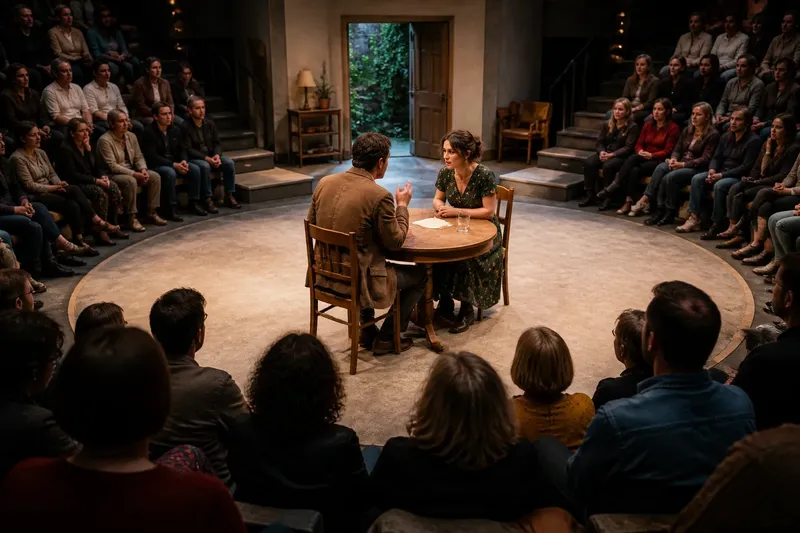
You find your seat in a theatre in the round, notice a doorway behind the stage, and realise that the person beside you has a view of something you cannot see. At your first visit to a theatre in the round, the room itself becomes part of the performance: actors approach from several directions, and each seat offers a different angle on the same action. Start by noticing how your viewpoint changes rather than trying to see everything at once.
Find your bearings
In a theatre in the round, the playing area is surrounded by audience seating. There may be no single front, and actors can face one section while showing their backs to another. Entrances might open directly into the auditorium, arrive through gaps between seats, or emerge from behind scenery. The arrangement varies, so take a quiet moment before the performance to notice what is visible from your seat.
Look for routes rather than trying to decode every feature. Where can a performer enter? Are there stairs, aisles or low platforms that appear to be part of the playing space? A visible doorway may be an entrance, but it might also be an ordinary part of the room. Treat it as a possibility, not a promise.
Choose a simple reference point, such as a central table or a patch of floor. It gives your eyes somewhere to return when movement crosses your view. You do not need to keep your attention fixed there; the point is to avoid feeling obliged to scan the whole room constantly.
Follow changing views
When an actor speaks, watch how the body turns as well as where the face points. In an end-on arrangement, the audience shares a broad front view. In the round, a performer may shift their address from one side to another, letting each group receive a moment of direct attention. A turn can also expose a gesture, prop or reaction that was hidden a moment earlier.
It is normal to miss a detail when someone or something blocks your line of sight. The obstruction may be brief, and another part of the scene may remain clear through movement, voice or the reactions around you. Rather than leaning or twisting repeatedly, stay comfortably seated and notice what the change in viewpoint does to your understanding.
Imagine an invented scene in which two characters argue over a letter at a small table. From your seat, one character’s hand is hidden by the other’s shoulder. When the second character turns to address a different section, you see the first quietly fold the letter. The changed angle reveals a choice that was concealed; it is not a failure of your seat. Notice how the actors distribute information across the room.
Track entrances and exits
Multiple entrances can make an arrival feel immediate. An actor stepping in from an aisle may seem to come from the audience’s own world, while an entrance through a doorway can establish a destination or boundary. Notice whether performers use the same route repeatedly, or whether a new direction changes the mood of their arrival.
Exits matter too. A character who leaves behind the audience may seem to withdraw from a conversation; one who crosses the open floor can carry the scene’s attention with them. Follow the departing figure with your eyes, then return to the remaining performers. Their stillness or response may tell you what the exit has changed.
Let the action arrive before you try to predict it. Then ask what the route adds: surprise, distance, intimacy, or a sense that the scene extends beyond the playing area.
Notice the audience
Surrounded seating means you can see other spectators as well as performers. A laugh, a collective stillness or a turn of heads may reveal where attention has moved. These reactions are part of the event, but they are not instructions about what you must feel. Use them as clues, then decide what the moment means to you.
At times, a performer may address one side of the room and leave the rest listening from an oblique angle. That unevenness can create a sense of overhearing. It can also make the audience visible to one another, so a quiet response from across the space may become part of your awareness. Allow this shared attention without feeling responsible for performing a reaction yourself.
Questions during the performance?
Should you keep turning your head?
Turn when the action gives you a reason, but do not try to monitor every entrance at once. A steady, comfortable view often reveals more than constant scanning.
What if an actor faces away?
Listen to the voice and watch the actor’s movement, then notice whether another performer’s face or response carries the moment. A turned back can be part of the scene’s address rather than a lost cue.
Can you choose the best seat?
There is no universally best view in a round arrangement; proximity, sightlines and access vary by venue and production. If you have a particular access need, ask the theatre about seating options before booking.
Carry one question
For the rest of the performance, try asking: who can see this action, and who cannot? The answer may shift as actors move, and it can help you notice how a scene parcels out knowledge. You might see a character’s expression while another section sees their hands, or watch one audience group become the focus while the others wait.
On a first visit to a theatre in the round, you do not need a complete map of the room or a perfect view of every gesture. Choose a reference point, follow a few routes, and let changing sightlines direct your attention. A small detail often repays that patience: when a performer turns, they reveal not only a new face but a new relationship between the scene and the people gathered around it.